‘Gates of Paradise’ finally to be unveiled in Florence after 27 years


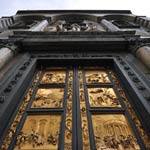
After more than 27 years, the restoration of Ghiberti’s ‘Gates of Paradise’ has been completed and the results will finally be unveiled to the public. Dubbed the ‘Gates of Paradise’ by Michelangelo, who was struck by their remarkable beauty and grandeur, the priceless bronze and gold doors of the Florence Baptistery are one of the masterpieces of the early Renaissance, even in all of Western art, according to experts. Lorenzo Ghiberti himself said: “It is the most singular work I have ever made and it was finished with all art measure and skill”.


The doors, divided up into 10 panels, each with a story from the Old Testament, were built between 1426 and 1452 and are located on the east side of the baptistery. Actually, the original doors have been replaced by copies since 1990, while the original ones have been kept in the Museo dell’Opera del Duomo. They had been removed once already in 1943 during World War II and then again for restoration after the flood of 1966.

Originally the Gates of Paradise were to have 28 figural panels and follow the quatrefoil design, as in the earlier sets of Baptistery doors located on the north side of the minor basilica, but this plan was scaled down to 10 panels, probably due to aesthetic concerns. Each of the 10 panels is surrounded by a border with 48 tiny images, including a self-portrait of the artist and representations of the prophets.

Gates of Paradise detail, bust of Ghiberti

Unlike the northern gates, the ‘Gates of Paradise’ are more naturalistic, with a new approach to human figure and perspective. The three panels that best illustrate this new approach are the Solomon, Joseph and Isaac.

'Jospeh' panel of the 'Gates of Paradise' by Lorenzo Ghiberti.


'Isaac' panel of the 'Gates of Paradise' by Lorenzo Ghiberti.

Note that the north gates, first on the east side, were moved to the northern side after completion of the ’Gates of Paradise’ because the latter were considered so perfect artistically speaking that they were placed at the main entrance, on the east side, facing the Cathedral. The frame of the first door, however, remained on the east side, forcing Ghiberti’s team to complete a new frame in all haste, which is still apparent from the details of the north gates’ frame.

North gate of Florence Baptistery

To create his bronzes, Ghiberti used the lost-wax casting (cire perdute) technique, a technique of bronze-casting used by the ancient Romans that the artist re-invented. He used a bronze alloy that was somewhat more difficult to cast than other bronzes of the period, but that was much more receptive to gilding. His training as a goldsmith allowed him to further perfect his technique and develop his innovative approach in creating a masterpiece.

The restoration, which took almost as long as it took Ghiberti and his assistants to make the gates, was carried out by Florence’s Opificio delle Pietre Dure. Important new insights into the fabrication process and the evolution of Ghiberti’s imagery and techniques that came to light during the restoration process (using new laser techniques) may be revealed in the future.

The Gates will now be permanently on display in the Museo dell‘Opera del Duomo from September 8 on, Culture Minister Lorenzo Ornaghi said this week.


You might also like:

 
Parma Baptistery: a testimony of that unique moment in time when Romanesque became Gothic


9 Art Cities in Emilia Romagna


7 unusual and legendary walls of Italy

While Italy is known for its many historic walls – Roman, Etruscan, Norman and Aragonese, among others – some Italian towns feature walls which have acquired fame for rather original and unusual reasons: walls of fame, love walls, challenging walls and… entire mural villages.
 

1. Muretto di Alassio

Muretto di Alassio

Muretto di Alassio. Photo: Corma


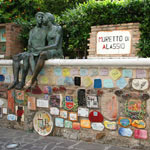
The Muretto di Alassio is a wall of the public gardens near the seafront of the town of Alassio consisting of 550 ceramic tiles signed by celebrities who visited the place in the past decades. The tradition was started in the 1950s at the initiative of a local painter who decided to post tiles signed by famous people who visited his father’s bar Caffè Roma. The first tile was posted by Ernest Hemingway. Since then, tiles decorated by various celebrities of film, theater, sport, music, and art – including Woody Allen, Charlie Chaplin, Anita Ekberg, and Jean Cocteau – have been added to the wall.


2. Juliet’s Wall, Verona

Love wall in Verona

Love wall in Verona. Photo by ell brown.

Juliet’s wall, also known as the Wall  of Love, is situated in the courtyard inner archway of the house where Juliet Capulet is supposed to have lived in Verona. The wall is covered with graffiti and notes left by visitors for their loved ones. It is said that if you have a special love request and paste it on the wall, your wish will be granted. The building, dating back to the 12th century, was owned by the Dal Cappello family. Identification of the name Cappello with that of the famous heroine of Shakespeare, Capuleti, gave rise to the popular belief that this was Juliet’s house. However, many features of the building including the famous balcony, were added during drastic restoration works carried out between 1936 and 1940.

Wall with love notes in Verona
 

3. Muretto dei Ciclisti, Laigueglia

A true attraction among cycling tourists, the Muretto dei Ciclisti of Laigueglia consists of tiles signed by the Gotha of champion cyclists.

Muretto dei Campioni Ciclisti of Laigueglia

Muretto of the Champion cyclists of Laigueglia. Source: Liguria2000News.com


4. Wall of Sormano

The Wall of Sormano, in the province of Como, is not actually a wall, but a road with such a legendary slope (experienced as virtually ‘vertical’ by cyclists) that it has been dubbed “Muro of Sormano”. Inserted by Vincenzo Torriani in the Giro di Lombardia in the 1960 – 1962 – in order to make the race, which he perceived as too ‘easy’, more challenging – the slope has since then become legendary for its toughness, forcing many champions to get off their bikes and continue on foot.

Sormano wall. Source: Flandria café


5. Mural village of Dozza

Located between Bologna and Imola, the small town of Dozza is known for its Rocca (fortress) and colorful murals in the borgo (medieval town center). More about the mural village of Dozza.


Mural village of Dozza. Photo by Loris Silvio Zecchinato


6. Painted village of Tinnura, Sardinia

One of the unexpected treasures of the Sardinian hinterland is the mural village of Tinnura. The small village of only 268 inhabitants is famous for its picturesque murals adorning the facades of the houses. The colorful murals depict scenes of the rural life in the area.


Tinnura walls. Photo by dapog.


Painted village of Tinnura

Painted village of Tinnura. Photo by dapog.

Tinnura walls. Photo by dapog.


Tinnura walls. Photo by dapog.


7. Wall of fame of Tocco Da Casauria (Pescara)

Wall of Fame of Tocco da Casauria. Photo by gabrdanh.

The Muretto of Tocco Da Casauria in the province of Pescara is decorated with the portraits of Frank Zappa, John Lennon, Sid Vicious, Kurt Cobain, Jim Morrison, Bob Marley, Jimi Hendrix, Jeff Buckley and Janis Joplin, among others.


You might also like:

 
The mural town of Dozza


Venetian bridges with the most unusual names


The multicolored chapel of La Morra


Meandering through Dozza’s multicolored murals

Dozza mural

Photo by mikedangeR


Dozza is a litttle town situated between Bologna and Imola, known for its Rocca (fortress) and colorful murals in the picturesque historic center (borgo).

A festival of murals takes place every two years, during which famous national and international artists decorate the town walls with murals based on perspective drawing, trompe-l’oeil and other wall painting techniques.

The paradoxical view of modern street art set in an ancient medieval town, dating back to 1126, is rather compelling.

Dozza street

Dozza street. Photo by Roby Ferrari

Dozza arch

Photo by malà vage


Dozza pink house

Photo by lo.tangelini

Dozza mural

Photo by lo.tangelini

Dozza mural

Photo by lo.tangelini

Photo by lo.tangelini

Photo by lo.tangelini

Photo by loriszecchinato

Photo by mikedangeR

dozza mural

Photo by loriszecchinato

Photo by lo.tangelini

Photo by lo.tangelini

Dozza table mural

Photo by lo.tangelini

Photo by lo.tangelini


From Bacon to The Beatles Exhibition in Milan

From Bacon to The Beatles Milan
Until February 12, 2012 “From Bacon to The Beatles”, a “mostra da ascoltare” in La Permanente, Milan

The exhibition “From  Bacon to The Beatles” offers a journey through the history of art in Europe during the years of rock’n roll. Innovative is that it analyses the figurative revolution of the 50s and 60s in the light of the contemporary musical revolution, highlighting influences and reciprocal inspirations.

It is the first exhibition with its own soundtrack juxtaposing works of masters such as the British artists Francis Bacon, Peter Blake and Richard Hamilton, the Italians Alberto Giacometti, Mimmo Rotella, Giuseppe Guerreschi and Mario Schifano, the American William Utermohlen, the German Horst Antes and the French Jean Dubuffet and Cesàr, with the music singed by The Beatles, Pink Floyd, Elvis, Hendrix, Joan Baez, Jim Morrison, Mick Jagger. The works on display include sculptures and mostly large scale paintings, which, set against the musical background, re-evoke the atmosphere of a period of great social, political and economic changes, from the Vietnam War to Woodstock.

Museo La Permanente. Via Filippo Turati 34, Milan, tel. 02 6599803.

Opening hours: Tue-Fri 10.00-13.00, 14.30-18.30, Sat-Sun 10.00-18.30.

Until February 12, 2012


Venice and Egypt Exhibition

Piece of the 14-panel weekday altarpiece (Pala feriale) by Paolo Veneziano and sons (1345) in which western and oriental elements are mixed. The work was commissioned by Doge Andrea Dandolo who was the first one to write down the legend of St. Mark. It shows parts of St. Mark’s life, the way doge’s described them.

Why is Venice the only European city that had its own name in Arabic?

Venice and Egypt exhibitionThe unique, thousand-year old, relationship between Venice and Egypt is narrated for the first time ever through more than 300 works in a Venice exhibition through January 22nd, 2012.

The exhibition, which will take place in the spectacular Sala dello Scrutinio (Voting Hall) of Palazzo Ducale, illustrates the relationship between “Venice and Egypt” over almost two millennia: from the archaeological findings that testify to relations during the Classic Age, to the opening of the Suez Canal a project that was originally suggested by the Venetian government at the turn of the sixteenth century and eventually only accomplished in 1869 against a project designed by Engineer Negrelli from Trento, the then director of the railways of the Lombardo-Veneto nation.

Al-bunduqia Venice in arabic

Source: B.I.S.

The exhibition depicts a vivid portrait of the special bond and closeness between two entire different worlds, such a strong relationship that Venice was the only European city that, from the year 1000 on, had it’s own name in Arabic, al-bunduqiyya. It’s a unique case because the word in Arabic has no resemblance to ‘Venice’ (Venezia in Italian) and it’s probably the only European city name that has a word of its own in Arabic. The word ‘AL-Bunduqia’ has two meanings: rifle and hazelnuts sweets (from Bunduq=hazelnut).

The Islamic influence on Venice can also be seen in its symbols and representations. One of the symbols of the ancient State of Venice is the Leone Marciano, a lion of Egyptian origin that comes from a heraldic emblem of a Cairo ruler. These are just a few examples of the many elements testifying of the profound exchange between Venice and the Islamic world, especially in the world of art. The influence was so omnipresent that Venice used to be called the Eastern Door of the Western World.

However, it was the love affair between the Serenissima and Egypt itself, and Alexandria in particular, that had an enormous symbolical and mythical significance for the Venetians. For it was from Alexandria that the remains of St. Mark had been hijacked by two Venetian merchants in 828, an event that, in the Venetian mind, came to be seen as the beginning of Venice’s rise to power, empire and immense wealth. The ancient mosaics in St. Mark’s Basilica depict the Lighthouse of Alexandria, one of the Seven Wonders of the World, still standing, together with other Egyptian backdrops featuring pyramids, palm trees and camels. Three adventurous travel writers and explorers, all of Venetian origin, also left records of their journeys in Egypt in the form of the antiquities, books, prints, paintings and drawings on show in the closing sections of the show.

Info: www.visitmuve.it

Image Venice etymology: Research project


Artissima International Fair of Contemporary Art Turin 2011

Artissima Turin. Photo by Max Tomasinelli.

Artissima, the trendiest international contemporary art fair will take place in Turin from November 4th to 6th 2011. The fair is exclusively devoted to contemporary art and to the newest and most emerging art trends, bringing together some of the world’s most prestigious galleries with the most innovative artists of the emerging generation. Within the fair Artissima has organized important exhibitions together with public institutions and private collectors as well as workshops and meetings with the most prominent museums directors and institutional italian and foreign representatives.  Besides the main section, Artissima offers three special sections: Present Future, New Entries and Constellations. Special section reserved to the newest art trends. A board of three international curators will invite a group of emerging artists to present a project at Artissima. Each selected artist will be exhibited by the reference gallery in a solo booth.

Following Folon in Florence Rose Garden

Photo by Marco Bellucci

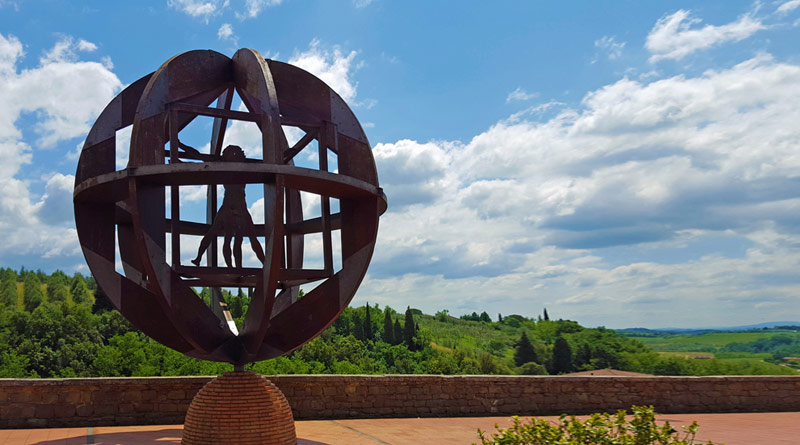
Recently, a permanent exhibition dedicated to the world-famous Belgian artist Jean Michel Folon opened in Florence’s Rose Garden, just off Piazzale Michelangelo.

Twelve bronze statues by the visionary artist now adorn the walks of the garden, in perfect symbiosis with the surrounding environment. Je me souviens, a work of 2003, features a male figure sitting on a bench ready to converse with whomever happens to come and sit next to him . A blue statue, Chat, represents a cat peacefully resting on the lawn surrounded by rose bushes.

The exhibition celebrates the dialogue between man and nature, between art and imagination. Folon used to say that “Toutes mes sculptures regardent le ciel, c’est une façon de mettre le ciel dans la sculpture” (all my sculptures look up at the sky, it is a way to put the sky into the sculpture). Actually, the sky he was referring to was the sky of Florence, as the town has always been a permanent reference point for Folon up to his last exhibition at Forte Belvedere, six years ago before his death.

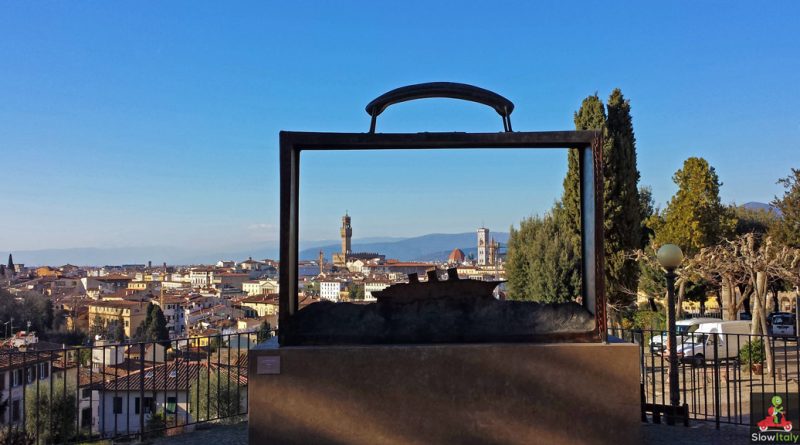
His wish to find a permanent home in the form of a garden where to settle his works was what convinced his widow, Paola Ghiringhelli, to bestow the twelve statues on Florence municipality.  Folon first fell in love with Florence as a young man, when he traveled through Italy hitchhiking. His last symbolic goodbye to the city and to world finds its expression in the sculpture Partir (leaving), standing at the entrance of the park. The work represents a visionary suitcase, in the shape of a big, rusty rectangle framing Florence’s skyline.